
India is currently navigating the most challenging phase of the pandemic. As a new variant drives an unprecedented spike in cases, the “Oxygen Crisis” has become the defining struggle of the summer. With hospital-grade cylinders in short supply and the healthcare system stretched to its limits, Oxygen Concentrators have emerged as the literal lifeline for thousands of families.
If you are managing a mild to moderate case at home—specifically with oxygen saturation ($SpO_2$) levels between 85% and 94%—a concentrator can provide the supplemental support needed to prevent the disease from progressing to a critical stage.
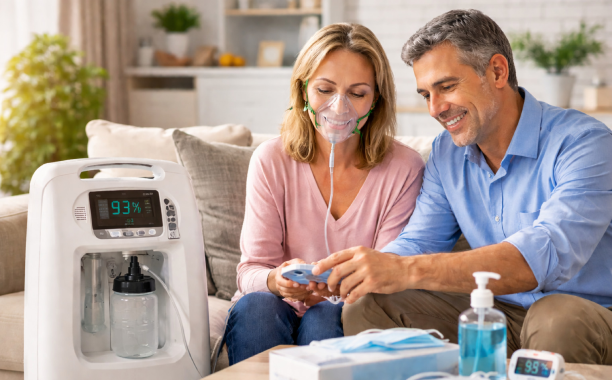
How Does it Work? (The Science of Zeolite)
Unlike cylinders, which store a finite amount of compressed gas, a concentrator is an “oxygen factory” that never runs out, provided it has a power source.
- Air Intake: The machine pulls in room air (which is roughly 78% Nitrogen and 21% Oxygen).
- Filtration: It passes the air through filters to remove dust and bacteria.
- The Sieve Bed: Using a material called Zeolite, the machine “scrubs” away the nitrogen.
- Delivery: What’s left is medical-grade oxygen (90-95% purity) delivered directly to the patient via a nasal cannula.
Note: Concentrators are designed for 24/7 use and can last up to 5 years with proper filter maintenance.
Choosing Your Device: Stationary vs. Portable
| Feature | Stationary (Home) Concentrator | Portable Oxygen Concentrator (POC) |
| Best For | High-flow, 24/7 home use | Active users and travel |
| Oxygen Flow | Continuous (up to 5L or 10L per min) | Pulse Flow (delivers puffs upon inhale) |
| Weight | 30–50+ lbs (has wheels) | 5–18 lbs (backpack/shoulder bag) |
| Power | AC wall outlet only | Battery, Car (DC), and AC |
| Price | More affordable | 3x to 6x costlier |
Buyer’s Checklist: Avoiding the “2021 Scams”
With high demand comes the risk of fraud. We’ve seen reports of people being sold “nebulizers” or “humidifiers” marketed as oxygen concentrators. Do not be fooled.
- Check the Flow Rate: For COVID-19 management, the Government of India and WHO recommend a flow rate of at least 5 Litres Per Minute (LPM) with a concentration of 90% or higher. Devices that only offer 1-2L are generally insufficient for coronavirus patients.
- Trust the Brands: Look for established names like Philips, Invacare, AirSep, Yuwell, Inogen, or Medtronic.
- Verified Platforms: Stick to authenticated health sites like 1mg or Nightingales India rather than unknown social media sellers.
Top Picks for 2021
1. The High-Flow Choice: Drive Medical DeVilbiss 10L
If a patient requires high doses of oxygen, this is a gold standard. It delivers up to 10LPM in a relatively compact 42-pound frame. It features bright LEDs and safety alarms to monitor purity levels in real-time.
2. The Lightweight Leader: Inogen At Home (5L)
At only 18 pounds, this is one of the lightest stationary units on the market. It is exceptionally quiet and energy-efficient—perfect for home recovery where noise can be a stress factor.
3. The Versatile Hybrid: OxLife Independence
This is a rare portable unit that allows you to switch between Pulse and Continuous modes. It’s FAA-approved for travel and features an integrated cart for easy movement.
The Crucial Difference: Concentrator vs. Cylinder
- Cylinders: Best for emergencies and very high-flow needs (above 10LPM). However, they require constant refilling and can run out in just a few hours.
- Concentrators: Perfect for sustained support. They offer “unlimited” oxygen as long as you have electricity, making them the superior choice for home isolation.
Final Word of Caution
An oxygen concentrator is a medical tool, not a miracle cure. If a patient’s $SpO_2$ falls below 85%, they require high-pressure hospital oxygen that only a ventilator or a high-flow cylinder can provide. Early detection and proactive monitoring with a pulse oximeter remain your best defense.